Fair Isle is one of the best-known colourwork traditions in the world. Its patterns are beautiful, its history is rich, and its name is known far beyond the shores of Shetland.
But that wider popularity has also created confusion.
Today, the phrase “Fair Isle” is often used to describe almost any knitted pattern made with two or more colours. A pair of Latvian mittens may be referred to as Fair Isle; a bulky yoke sweater from Iceland may be labeled the same. It's not uncommon to see jumpers in catalogues with animals forming the pattern that are referred to as Fair Isle.
But not all stranded colourwork is Fair Isle. Fair Isle is one tradition within a much wider family of colourwork knitting.
What is stranded colourwork?
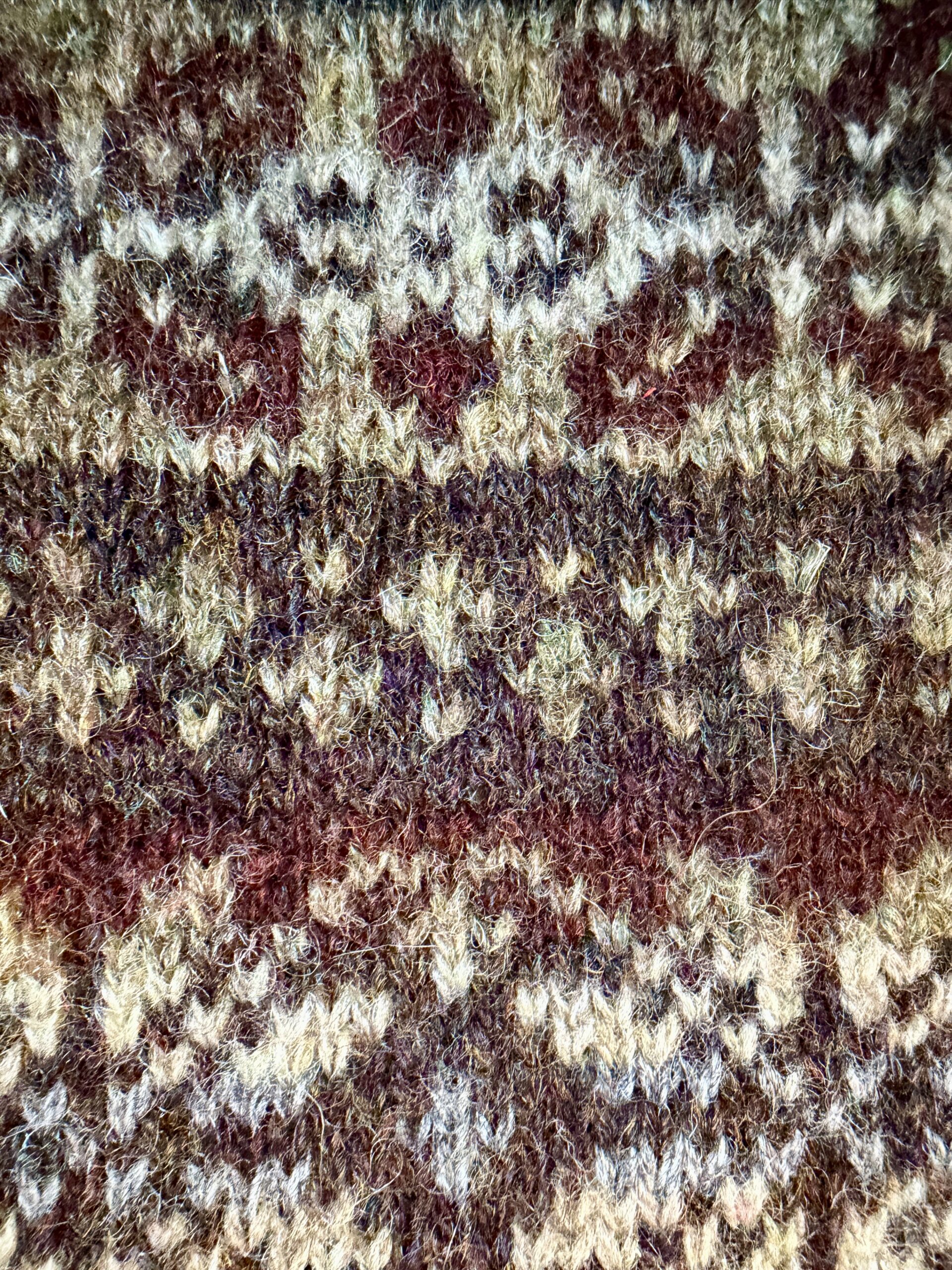
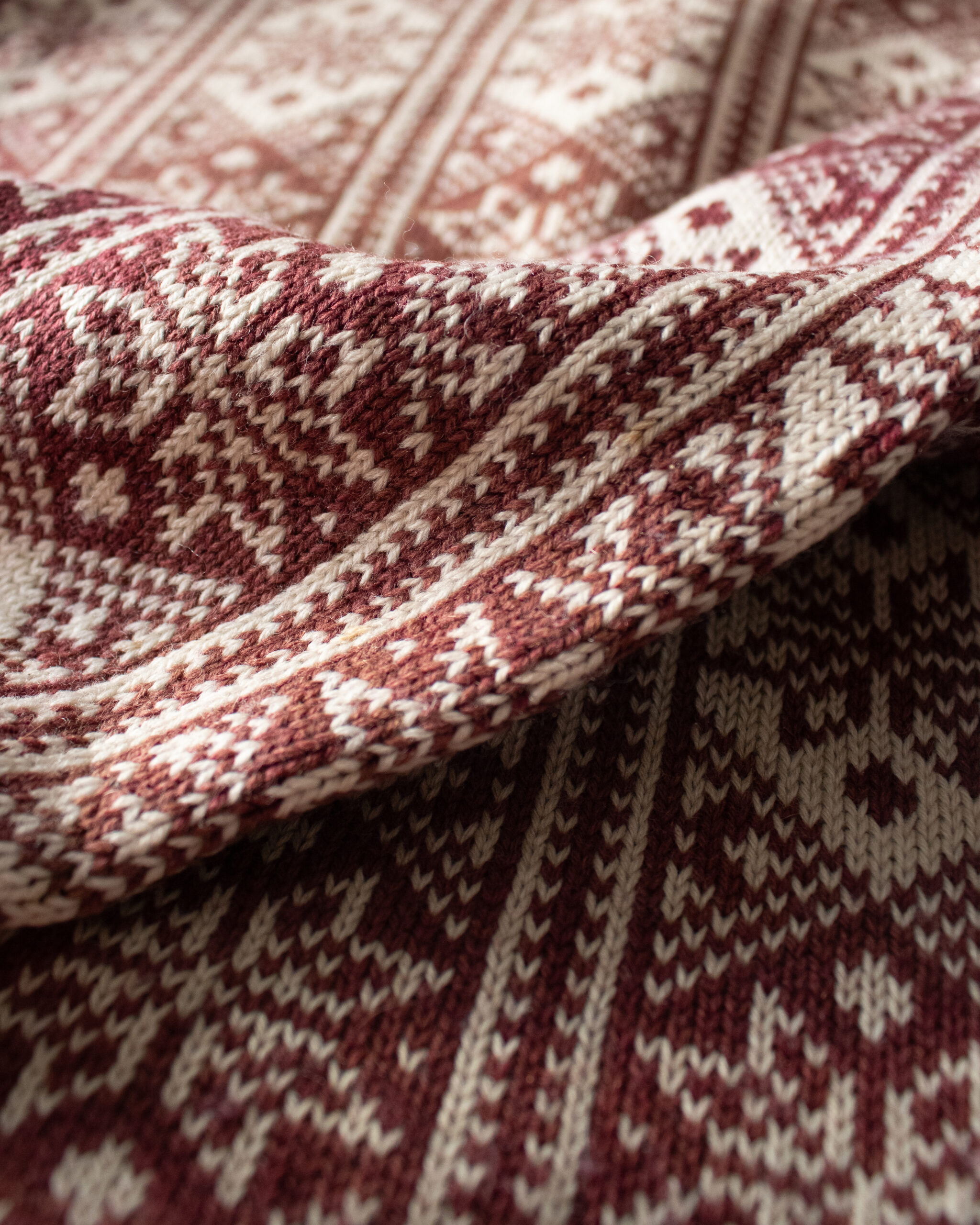
Stranded colourwork is a knitting technique in which two or more colours are used across a row or round. The colour not being used at that moment is carried behind the stitches. These carried yarns are often called floats. This method allows knitters to create a patterned fabric of geometric motifs, flowers, animals, stars, and more.
Stranded colourwork is found in many knitting traditions around the world, including Fair Isle, Selbu, Bohus, Muhu, Lopapeysa, Latvian mitten knitting, Andean colourwork, and more.
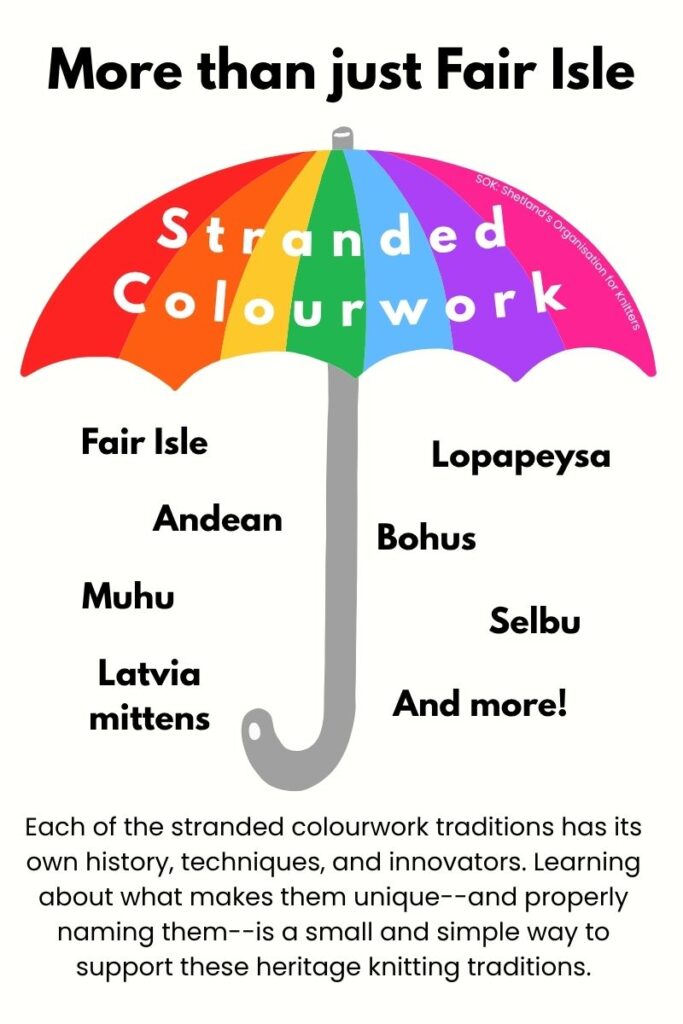
But the fact that these traditions all use stranded colourwork does not mean they are the same. They may create similar fabric, but they do not share the same design, history, or cultural meaning. They may also vary in construction, yarn handling and finishing.
These differences are why the names of these knitting traditions matter.
So what makes Fair Isle different?
Fair Isle knitting is named for Fair Isle, the Shetland isle where the tradition developed. It has its own character and design tradition.
Fair Isle knitting is almost exclusively worked with no more than two colours in any one row. The patterns nearly always feature symmetrical geometric motifs, and the colours used are carefully balanced, with attention to shading from one colour to the next and a clear contrast between the background colour and the pattern colour. The motifs are arranged in horizontal, vertical, or diagonal repeats, with attention to orderly pattern placement.
Fair Isle knitting is also tied to Shetland wool, Shetland makers, and Shetland’s working history. It belongs to a place, a community, and a continuous line of skill passed between knitters.
That does not mean the tradition never changes. Living traditions do change. Knitters adapt to new styles. Colour preferences change with the times. New designers interpret old ideas in new ways.
But this change is part of the tradition itself. A living tradition can grow while still being understood clearly.
Why does this confusion happen?
Part of the confusion comes from fashion. For many, “Fair Isle” has become a catch-all term that simply means knitwear made in more than one colour, regardless of whether it reflects Fair Isle knitting tradition.
Part of the confusion also comes from knitting patterns and magazines. For many years, “Fair Isle” has been used as a convenient shorthand for stranded colourwork. It is a familiar term, so it gets used even when the design is clearly drawing from another stranded colourwork tradition.
And part of the confusion comes from the fact that many stranded colourwork traditions do share broad similarities. Several of the traditions share common motifs, for instance. Some of the traditions also only use two colours in one round.
But shared technique does not make them the same tradition.
Selbu mittens are not Fair Isle dags. A Bohus scarf is not a Fair Isle graavit. A Lopapeysa is not a Fair Isle jumper. A Muhu sock is not a Fair Isle fitty. An Andean hat is not a Fair Isle toorie.
That is not to take away from any of the other knitting traditions. Just the opposite: they each deserve to be named and understood on their own terms.
Why accurate naming matters
Using the right name of a knitting tradition is not about catching people out. Most people who use “Fair Isle” broadly are not trying to erase anyone’s heritage. They are using the word they have seen in shops, patterns, and online spaces.
But when we know more, we can speak with more care. Accurate naming helps protect the stories behind the work. It reminds us that these knitting traditions were shaped by real communities. They were carried forward by skilled hands. They were part of local economies, family knowledge, trade, identity, and daily life.
When every stranded colourwork design is called Fair Isle, the knitting tradition becomes diluted.
At the same time, when every stranded colourwork design is called Fair Isle, it erases the unique histories, techniques, and makers behind the traditions of the Baltics, the Andes, Scandinavia, Germany, Portugal, and more.
Using the proper names for heritage knitting traditions gives each one room to stand.
Proper naming helps learners understand what they are making. It helps teachers explain techniques more clearly. It helps designers describe their work more accurately. It helps shoppers understand what they are buying. It helps communities protect their own heritage.
How learners can use the terms
If you are not sure whether something is Fair Isle, it is usually safer to call it stranded colourwork. It is the broad term for multicoloured knitting in which the unused yarns are carried at the back of the work.
If you are speaking about work that comes from the Fair Isle tradition, or has been clearly designed within that tradition, then Fair Isle is the right name.
If you see clear elements of Fair Isle knitting, but the designer has added a twist of their own, you can make that clear by using words like 'inspired by' or 'drawn from' Fair Isle knitting.
Some helpful phrases to keep in mind:
“This is stranded colourwork.”
“This is inspired by Fair Isle knitting.”
“This uses Fair Isle-style motifs.”
“This is a traditional Fair Isle pattern.”
Making the effort to identify Fair Isle accurately can have a big impact in preserving this heritage craft.
Celebrating the wider world of stranded colourwork
One of the pleasures of knitting is discovering how many communities have used colour, pattern, and wool in distinct ways. Many of the knitters in Shetland enjoy knitting colourwork projects from other heritage traditions. Bulky Lopapeysa jumpers are a common sight in Shetland. Some local knitters are addicted to creating densely knit Latvian mittens. (You sometimes see traditional toories to which the Shetland knitter has added a Latvian braid.) There are Shetland knitters dealing with arthritis or other hand ailments who have found that Andean techniques allow them to keep knitting.
These traditions are all interesting in their own ways. They all create beautiful items people want to wear. They should not be generically labelled as Fair Isle. They are more interesting when we let them be specific.
Where SOK stands
SOK exists to preserve and protect Shetland’s knitting heritage. That includes Fair Isle knitting, Shetland lace, and domestic machine knitting. Part of that work is education. We want learners, visitors, designers, makers, and the wider public to understand Fair Isle as a living Shetland tradition, not just a pattern label.
That does not mean people outwith Shetland cannot learn from Fair Isle knitting. Of course they can.
Learning is one of the ways traditions continue to be valued. But learning works best when it begins with respect. That means listening to people connected to the tradition, using accurate language, and recognising the difference between a technique and a heritage practice.
Fair Isle is beautiful.
So are many other forms of stranded colourwork.
Naming them well helps us honour them all.